







Author Archive

New Year wishes
Friday, December 31st, 2010Every new year deserves a list. We produced our first one last year. If this year’s version reminds you of what we wrote twelve months ago, it may say something about the state of the nation and our state of mind!
So here’s our Malta wish list for 2011 – what we’d like to see more and less of, over the next 365 days of living and working in Malta.
LESS
1. Bad Roads. We’re in the second decade of the new millennium. Yet we still have flood zones and no-go areas every time there’s a heavy downpour. People still die on the roads because of pot-holes, bad-grip, poor lighting and more. What happened to the infrastructure money that was supposed to be invested in our road infrastructure?
2. Dogma. It’s not just the lack of an intelligent discussion on important issues such as divorce. It’s the celebration of polarisation which gets to us, sometimes.
3. Noise-pollution. Shotgun pellets, petards, damaged exhaust pipes, fierce church bells at five in the morning, planes doing practice landings at Malta Airport because it’s cheaper here than West Germany.
4. Fake bi-lingualism. We’re supposed to be able to communicate in Maltese and English. With the current education curriculum, we risk churning out a generation than can do neither. We cannot assume that both languages are taught in the home. There are many foreigners moving to Malta and sending their kids to school. The fabric of our society is changing as we speak, whether we like it or not.
5. Racism. It’s alive and kicking and sits very uncomfortably with our post-colonial history and Christian upbringing. Islands that look inwards cannot be happy places.
MORE
1. Greenery. There are pockets of scrub land we can recover. Illegal buildings that can be demolished to make way for open spaces. We drive round green roundabouts. How about some gardens where there are none?
2. Books. We love games and the iPad as much as anyone else, but there is an ever-greater need for kids to get their arsenal of communication skills locked in. We need libraries in each town.
3. Disability-sensitivity. Many parts of Malta and Gozo are inaccessible to people with wheel-chairs. It’s time for Malta’s laws to be aligned with those in the EU to facilitate community-living for people with disabilities.
4. Wi-fi. An old favourite. Every square in every village should be wi-fi enabled.
5. Citizen media. We may be in the era of WikiLeaks but you can still see blatant patronage and abuse of power, at the most micro of levels. Start a blog, start a Facebook page, go on Twitter, do some citizen journalism. You too have a voice, and have the tools to make it heard.
Happy new year to you all.
Photo: Leslie Vella


The Crossing
Thursday, December 30th, 2010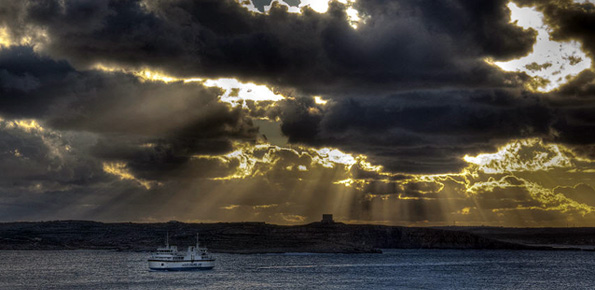
The constant crossing of the water
The channel between Malta and Gozo is just 5 kms wide, and it takes less than 25 minutes for the ferry to cross from one island to the next. And yet, it’s one of the most evocative journeys we are likely to make in our lifetime - probably the first to be burnt into our memory banks.
No matter how many times we’ve made the crossing, no matter the weather, you will find children of all ages on deck when the ferry is about to head out of Cirkewwa, when it is hovering past the entrance to the Blue Lagoon in Comino, when it is approaching Mgarr.
Catching the ferry is part of our vernacular - whether you just visit the other island a couple of times a year, or you’re part of that hardy, almost mythical tribe rom the sister island of Gozo that braves the daily crossing. You must know some of them: they arrive slightly dissheveled for a morning meeting, do nervous clock-watching in the afternoons, and spend weekends in what is still the greener, softer of our three islands.
The crossing is a gentle assault to our senses. For we all have pictures in our head from our time on a ferry.
We can still, if we focus, feel the wind in our hair, taste the ice-cream shared on a slatted bench, remember a snatched conversation. Laughter. And then the descent - to the sickly sweet smell of gasoline in the hold, as you struggle to get into your car, bending car mirrors, or shuffling out as a foot-passenger. Knowing that at some stage, the nose-cone will open and you, too, will drive or walk out. And transit - to the other island, to what’s next.
Photo: Mario George Vella
The Christmas hamper
Friday, December 24th, 2010I was woken up this morning by a man delivering a very large Christmas hamper. The people who sent the hamper are generous way beyond the twenty three items I later counted in the wicker basket.
This island has a long tradition of giving, at this time of the year. It extends beyond the Christian legacy, the marathon telethons and visits to orphanages. Christmas in these parts is also about stopping, for a second, to take stock of what we have. To reach out to people, count our blessings. And then move on.
Malta Inside Out continues to be our way of reaching out. When we started, in early 2009, we were writing to an imaginary reader. Slowly, and with the help of people interested in sharing ideas, photos, opinions, tips or plain anecdotes, this project has morphed into an online community of Malta insiders. The social glue between the people who write, contribute, read, comment and ‘like’ a post, and who may never meet each other in real life - is that this space is about people who care about the island. Whether they are compelled to sing its praises, or use a post as a soapbox to highlight the need for change.
We have grown quietly without any investment in advertising, lobbying or ownership of a printing press.
Hopefully, in 2011, we will find new ways of engagement - and really turn Malta Inside Out into a community of practice.
Have a great Christmas.
Pork in the square
Saturday, December 4th, 2010When you live in a village core close to a lovely square, you have to be prepared for the occasional invasion.
Tomorrow, Sunday 5th December, the usually serene St Nicholas Square in Siggiewi, will host the Pork Feast, or Festa tal-Majjal. The event is organised by the Koperattiva ta’ Min Riabbi l-Majjal, a cooperative of 150 producers of Maltese pork. The official bumph says that ‘the activity is being organised to increase the appreciation of genuine Maltese Pork in a cheerful festive atmosphere, an appetising food aroma, music and activities for the whole family’. And if you want to get close to the raw material itself, there are also pig farm visits, with transportation to and from St. Nicholas Square for €1 per person.
If you’re a vegetarian, you’re never going to understand these kind of ‘events’ - though in nearby Tuscany, meat festivals are a weekend tradition. If you do eat meat, this is an excuse to roam around my village pjazza and get a glimpse of how farming roots are still strong in this part of the island. There will be speeches, singing, dancing, local luminaries and bell-ringing. Munch porchetta, buy some decent local produce, watch the local folk in their Sunday best and the curious townies, and say hello to St Nicholas in the hub of it all.
If you want more information, access the event’s website in Maltese. Or watch the video below for last year’s edition in Zebbug for a slightly bizarre mix of meat and local talent on display.
Photo: wEnDaLicious
We are a Kiosk
Thursday, December 2nd, 2010
There's a kiosk serving food and gossip just round the corner
Last Saturday, I found myself on a radio programme to talk about the Internet and Maltese society. I took my son with me because he loves history and technology. I thought there was something very poignant about an eight year-old digital native meeting-old fashioned radio for the first time. Even more so because of the chequered early eighties legacy of the building we were in, when broadcast media and political propaganda became one and the same thing.
I spent a happy hour chatting to bloggers and geeks, experiencing first-hand how social media is gently moulding radio, making it more relevant, personal and downloadable. And my son drew cartoons of men with large heads and a larger microphone.
In Malta, distances are what they are, everything is cheek by jowl. You transit from one world to another in minutes. This Saturday morning may have been about radio, but Saturdays are also about fathers, sons and snacks. In twenty minutes, we’d headed south to the narrow streets of Vittoriosa and on to the Cafe du Brazil in the corner of Misrah ir-Rebha (Victory Square). A seat outside the cafe is a great vantage point for people-watching. It’s not quite the designer sun-glassed brigade of the Sliema front, so it’s easy to spot the odd tourist with the lens. But the old city is adapting to the new visitors. At the Cafe du Brazil, you now get a printed menu, and wraps and vegetarian options together with the more traditional, delicious, heart-burning ftiras. Trust me, on a warm late November day, there is no better place to sip a cappuccino, while the time away and ghost into your neighbour’s conversation.
Somehow, even after the toasted sandwiches, we found space for pastizzi from the band club and a green cassatella from the confectioner next door. The short stroll down to the water front was an excuse to marvel at the super yachts and burn up a few calories.
On our way home, we must have driven by three or four busy kiosks on either side of the road. All of them had people queuing up for something. Some had chairs outside. My head was still spinning in the space where history meets old radio and Facebook - about the state of the nation, identity in 21st century Malta, the vagrancies of ‘the smart island’. And from there, through some mental hyperlink, something must have clicked and I thought: “We are a kiosk.”
Think about it. Maltese kiosks are all about snacks and networks. Food and conversations. Queuing for a bite to eat or the daily newspaper. We are a nation of islanders who eagerly embrace the new technologies and shiny devices, but also stick to what we know best. We may love our Facebook, but we equally love our hobz biz-zejt with chips from the guy in the van who is more in touch with the pulse of the nation than any journalist. We’re very 21st century and stubborn, insular, opinionated. We will not blink if someone deposits one of these kiosks, a digital migrant, in our village square, but the chances are that we will still drift to the little van and get our hands dirty if we had a choice.
Photo: courtesy Soroll
Taking sides: Malta’s politicised media & society
Sunday, November 21st, 2010
The drop's transparent and knows no colour
Much is made of the colours of Malta, but when it comes to politics, only two really matter - the blue of the Partit Nazzjonalista (PN) and the red of the Partit Laburista (PL). The PN has been in power since 1987, with a break of 22 months between 1996 and 1998. And the media reflects this polarisation, with the political parties with their arsenal of print, TV, radio and Internet broadcasting channels preaching to their converted. The conservative Times of Malta has migrated its powerful print brand seamlessly online, with the support of a new bandwagon of online ‘citizen commentators’ - a veritable reincarnation of the village pjazza. And Malta Today and The Malta Independent are left to battle it out for the ‘independent voice’ that, inevitably, depends much on the support of advertising revenues to survive in a micro-market.
Excuse the overly academic references here, but I feel the paragraphs below that I draw from Carmen Sammut’s excellent Media and Maltese Society (2007, p.37) capture some of the zeitgeist of the media and so-called ‘free-thinking’ in this country.
“Since debate is dominated by the bi-partisan agenda, discourses that are framed outside this realm are cynically viewed and so journalists have difficulties asserting their independence. There seems to be little room outside the parameters of affiliated quarters. Technocrats, professionals and intellectuals are not perceived to be able to exist separately from (political) parties. It is not deemed possible for individuals to place national interests before party affiliation, wrote Pirotta (1997), who suggested that as a result individuals often find it more beneficial to take sides. Similarly, Baldacchino noted that whoever declines to adopt a political profile has less “social credit facilities” (Baldacchino & Scicluna, 1994, p.7).
So, while the Maltese, under political and religious influences, are highly opinionated, there is a scarcity of open critical thinking and analyses that challenge the duopoly in public, even if people are highly critical at a personal level. With few exceptions, the mass media tend to reflect this state of affairs. Journalists find it hard to quote critical non-partisan sources and experts. “Very few intellectuals stand up to be counted… We pay lip service to ‘civil society’ when there is widespread apathy.” (Editor, Malta Today, personal communication 2006).”
Yet, here we are, at the tail end of 2010, in the middle of a debate on divorce that has seen members of the two main parties and Alternattiva Demokratika participate in a strategic committee for a ‘yes vote’ for a private member’s Divorce Bill. The Church, the third powerful hegemonic force, together with the political parties and the media, is facing online cross-fire from citizens requesting an end to theocracy when it comes to what many perceive to be a ‘civil right.’
And in just over two years’ time, citizens will be asked to go out and vote - when it is increasingly easier for them, with the help of technologies like blogs and social networks, to raise their voices, publish, network and influence the public sphere without necessarily trying to beg for attention from the traditional gate-keepers of public opinion operating TV, print and radio.
Let me frame this in a different way. We still operate in a system where not being visibly affiliated with one of the two parties is tantamount to being an ‘opportunist’ - someone who cannot be trusted. A ‘laghaqi’. And yet, it is these same silent ‘opportunists’ - the so-called ‘floating voters’ - who have their say once every five years, and decide who to elect in Government. It is as if their existence is only acknowledged once, every five years. And after they have done their duty, they are expected to fade back to the background of their middle-class jobs and invisible lives and leave the public space for the polarised majority - to negotiate for the scraps of social capital and the right to influence their political masters.
I sense that something may be changing. In the same way many of us and our children have switched off TV and watch what we want online and chat to friends on the other side of the world on a regular basis. We publish what we want to say on sites like this. We are starting to choose how we want our lives to be mediated.
Perhaps, we may be slowly reaching a stage in our history when we can finally stop having to take sides for life, and having to embrace life-long systems of patronage and powerful intermediaries to help navigate our lives.
Perhaps, we are starting to grow up. Perhaps.
Photo: Courtesy of Daniel Borg


